In a zigging world where everything tech is connected online, firefighter-run Open Scaffold Labs zagged and made its hazmat resource platform FireHazmat off line. Co-founder and fire captain Matt Lavin talked to us about their new resource tool and what went into making it happen.
What inspired your initial idea?
I started my career assigned to a firehouse that ran a hazmat unit for the Hudson County Hazmat Task Force. On a call I’d have the ERG book in one hand, WISER on a device, CAMEO somewhere else, the NIOSH Pocket Guide for exposure limits, and a clunky, outdated weather station for wind. Five tools, five places, one incident, and a clock running. I kept asking how the fire service had fallen this far behind, and why nobody had put these in one place. Then NLM discontinued WISER in 2023 and the official guidance was essentially to go back to using several separate tools. That settled it for me.
How did that idea evolve into what we see today?
For years it stayed an idea, because I’m a fire captain, not a software company. What changed is that AI-assisted development got good enough that one person with domain knowledge could actually build it. I knew exactly what was wrong with the workflow because I’d lived it on real calls.
Also Read: Company Profile: HazTech’s In-Field Materials ID Kit
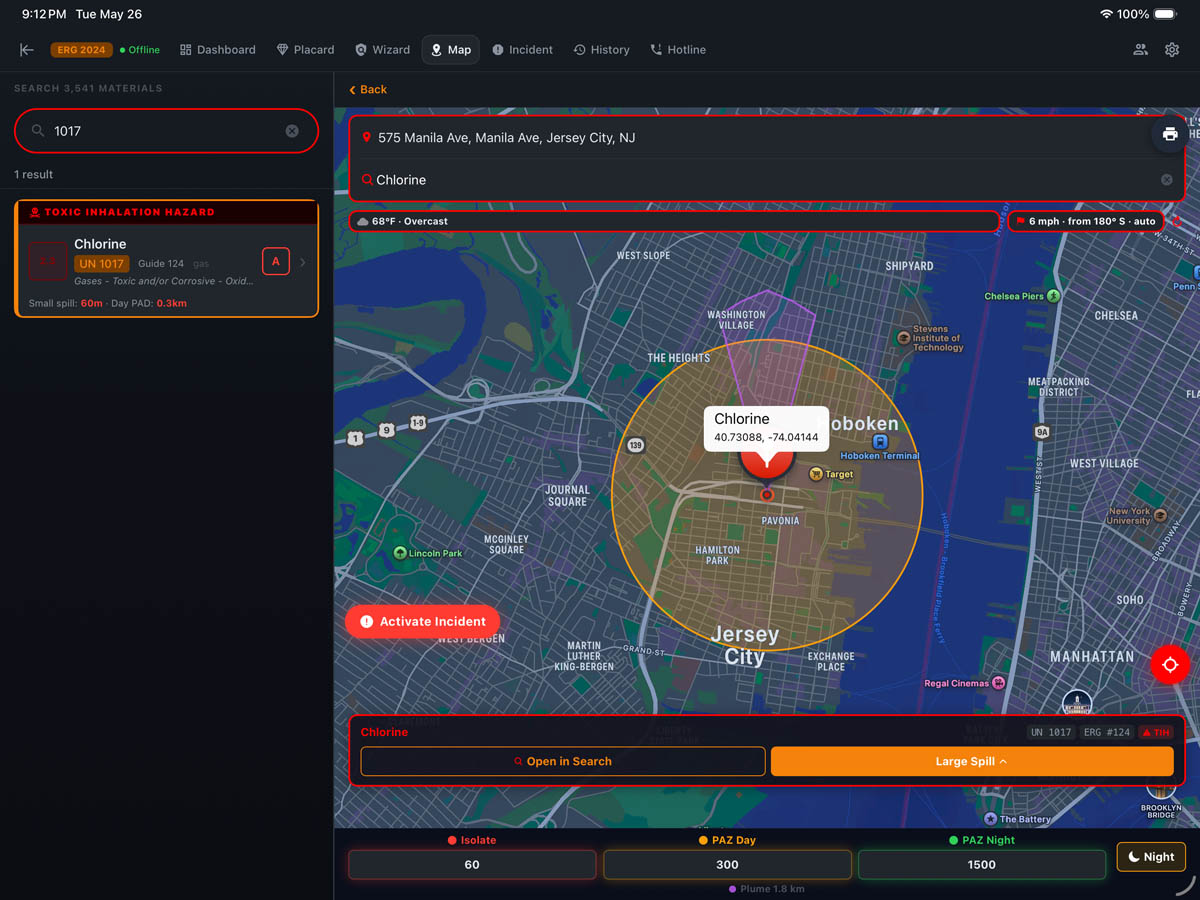
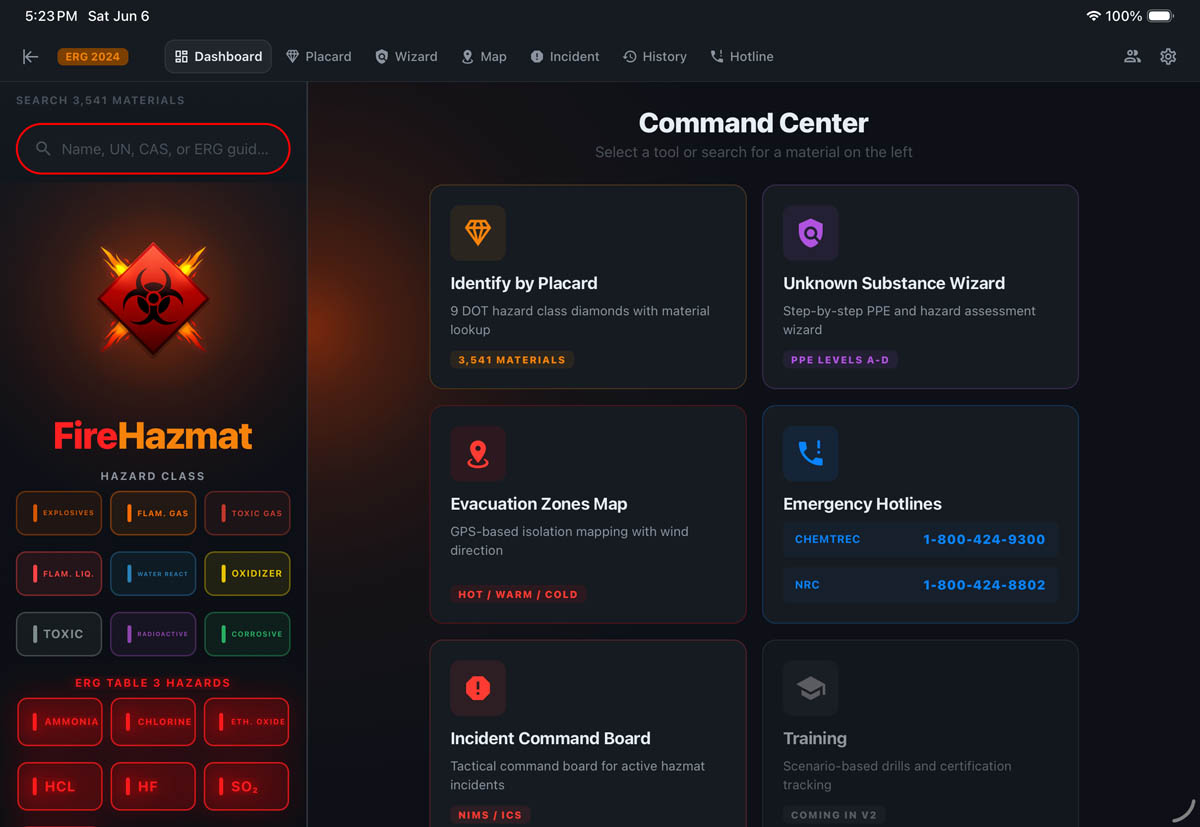
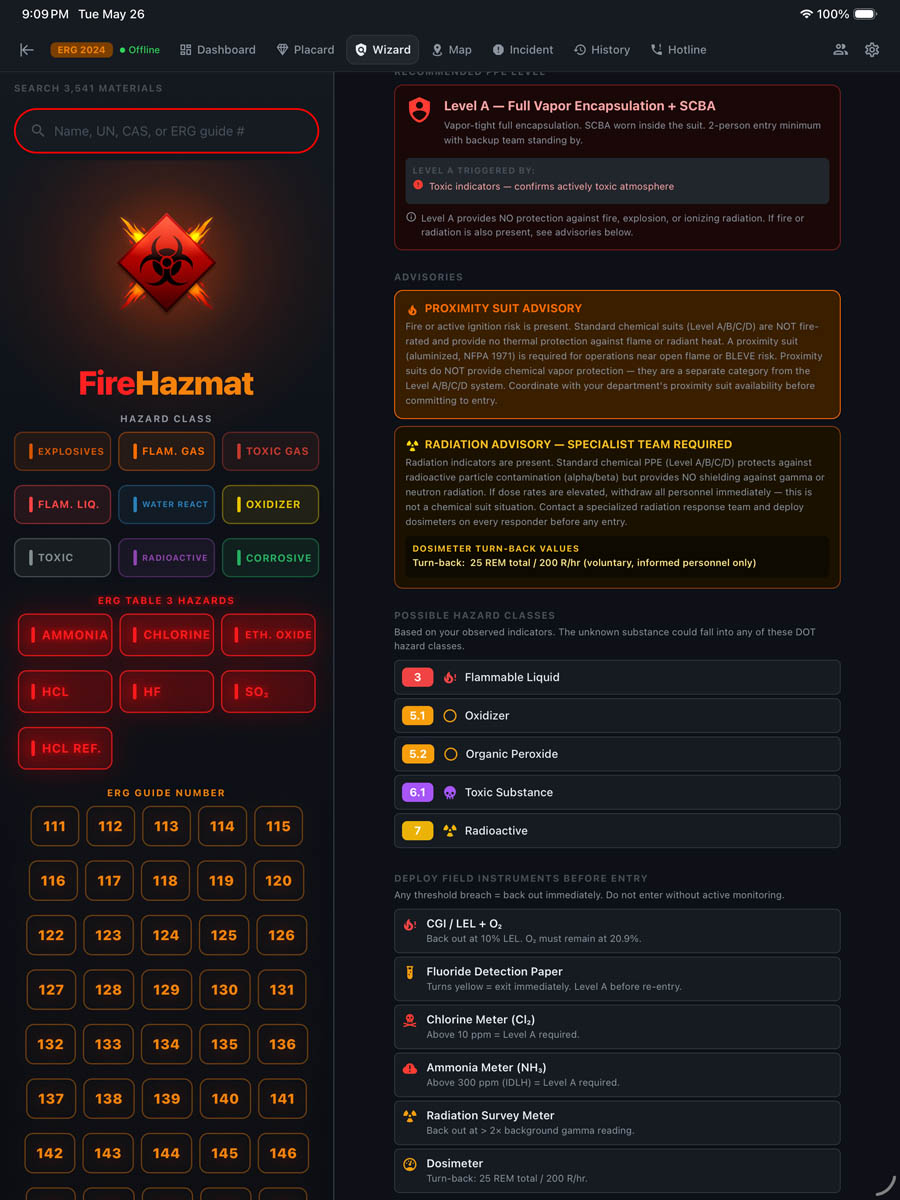
FireHazmat is the complete ERG 2024 with every entry extended by the data you’d otherwise go hunting for — IDLH and exposure limits from the NIOSH Pocket Guide, physical properties from PubChem, hazard-class detail from 49 CFR — plus placard identification, day/night protective-action distances, one-tap CHEMTREC and NRC dialing, and an unknown-substance wizard that works from what you can observe on scene. All of it offline, because the calls where you need it most are the ones where you have no signal. The apparatus tier adds live evacuation mapping with weather-driven plume modeling and a NIMS/ICS incident command board for the iPad or laptop in the rig.
What did you learn from early failures?
This is the one I’d want other builders to hear. Early on I enriched the chemical data from whatever sources returned good-looking values, and some of them were commercial or couldn’t be verified.
It looked fine. It was not fine. A wrong IDLH or a wrong flash point on a screen a commander is trusting at 3 a.m. is not a software bug — it’s a safety failure. So I stopped and spent months tearing it back out: every value in the database now traces to ERG 2024, 49 CFR, the NIOSH Pocket Guide, or PubChem, and the build refuses to ship if any value carries a source that isn’t on that list. Roughly 9,000 unverified values got re-sourced or deleted. It cost us real time, it was the right call, and it’s the part of this I’d defend hardest.
What have you learned from taking your product into the hazmat market?
That responders are appropriately suspicious, and they should be. The first question is always where the numbers come from — which is why every value in the app cites its government source on screen. The second thing I learned is that “free” gets read as “there’s a catch.” There isn’t one: the phone version is free with no subscription, no signup, and no tracking, because a firefighter shouldn’t have to expense a reference tool.
What has been the most profound story you have heard from a customer?
It’s less a single customer story and more what happened around the people I told. I built a product that works better as a reference tool than anything I’ve used on the job — and until about five months ago, when all of this began, I had no background in app development at all. So when I told people what I was doing, it wasn’t taken very seriously. I don’t blame anyone for being skeptical; if you’d asked me 12 months ago whether I could see myself building an app, I’d have looked at you sideways.
HazSim Training Drill: Chlorine Release From a Cylinder
We’re entering a new age of innovation, and the playing field has opened to the point where anyone with an idea can bring it to life — it comes down to how much time you’re willing to sacrifice now, not how much code you know, the way it used to be. Now that the app is officially on the App Store, the feedback has been the best part: the people who were skeptical are as impressed as I am with what we were able to put out with FireHazmat. And it’s only going to get better from here.
What’s the biggest misconception about Open Scaffold Labs’ role in emergency response (specifically hazmat)?
Two, really. The first is that there’s a big software vendor behind this. There isn’t — Open Scaffold Labs is two people, self-funded, and the person who built FireHazmat is an active career fire captain and hazmat technician who still rides a rig.
The second is that a tool like this is trying to replace training or the book. It isn’t. It’s faster access to the same public-domain data you’re already supposed to be using, with the page-flipping and arithmetic taken out. It doesn’t make decisions and it doesn’t replace a technician’s judgment. If your department has a current ERG and a trained crew, this makes them faster — it doesn’t make them unnecessary.
For a hazmat team, what’s the biggest barrier to entry?
Honestly? That the book already works. Asking a company to trust a phone over something that’s ridden in the rig for 20 years is a real ask, and the crews with the strongest habits are the hardest sell. The flip side is that the departments running the oldest paper ERG in the compartment are the ones who benefit most, and they’re often the ones with the least budget. That’s a lot of why the phone version is free — there’s no procurement process standing between a firefighter and a current reference.
What problem keeps you up at night?
Data accuracy. It’s why we ran countless audits and tests on every value in the app before it ever shipped — and why we keep running them. Hazmat calls aren’t like fires and the other things we respond to on a daily basis; they’re low-frequency and high-consequence. And that’s exactly when you lean hardest on your tools and references. I’ve been on those calls, so I know what it means to trust a number on a screen — a wrong exposure limit or a wrong isolation distance isn’t a software bug, it’s someone getting hurt. That’s why every value in FireHazmat traces to a government source and the build refuses to ship if one doesn’t — and that standard never relaxes.
What does the near-term future look like for your company?
For FireHazmat, it’s getting it into hands. I’ve offered it to all 50 state emergency response commissions; several states have started routing it to their regional hazmat teams. We’re supporting department evaluations with free 30-day licenses for the apparatus tier.
But the bigger near-term story is OpenFirehouse — the product Open Scaffold Labs actually started with. It’s a full fire-department records management system: pre-plans, inspections, live dispatch feeds with mapping, NERIS records, and more, all integrated with each other in one open-source platform. And volunteer departments will have the option to host it themselves for free.
The idea for FireHazmat actually came along while I was building OpenFirehouse. It’s packed with state-of-the-art features, which is why it’s taking longer to build, but we’re in the closing stretch now and it should be available this coming quarter. With where this technology has gone, it’s time these tools are built by the people who actually do the job — not by a tech company whose only goal is profit.
What does the long-term future look like for your company?
Keeping it current and keeping it honest — ERG updates as they’re published, source data that never drifts, and staying out of the trap the tools I grew up on fell into. WISER disappearing taught me that a reference tool responders depend on shouldn’t be able to vanish on them.
Longer term, FireHazmat is just the first to ship of the family of tools Open Scaffold Labs is building for the fire service — same philosophy throughout: built by people who do the job, priced so the people who need it most can actually have it.
What’s your boldest prediction for Open Scaffold Labs’ future role in hazmat and emergency response?
Within a few years, the standard picture of a hazmat response won’t be a book in one hand, a laptop in the other, and a separate weather feed — it’ll be one screen in the rig that’s current, sourced, and works with no signal. I intend for us to be the ones who made that normal.
And I don’t think it stops with the fire service. The same problem exists anywhere people respond to chemical hazards — military CBRN units, industrial response teams, emergency management. FireHazmat is built around firefighters and hazmat technicians today, but the bold version of this is Open Scaffold Labs becoming the trusted reference layer for hazardous-materials response across all of it, the military sector included.