By Logan F. Martin, PhD, CIH, CSP, CHMM, is the founder and principal of LF Martin LLC, a firm providing safety consulting, OSHA compliance support, expert witness testimony, and industrial hygiene services. Follow Dr. Martin at https://www.linkedin.com/in/drmartinsafety
Part 1 of a two-part series.
Dedicated to all of the safety professionals, fire officers, and anyone who has ever said “we monitored the atmosphere and it was clear.”
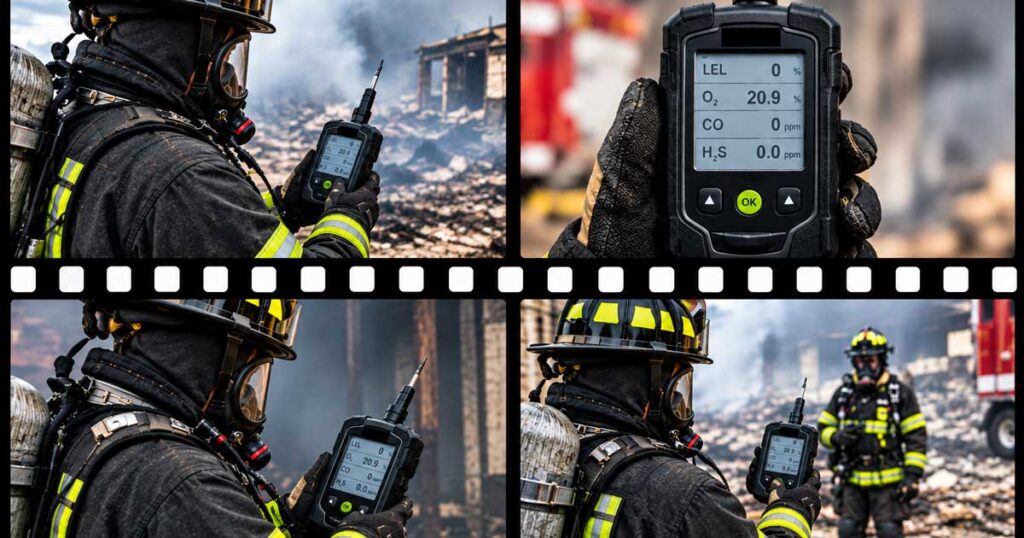
A crew responds to a reported odor at a strip mall. The four-gas meter reads 20.9% oxygen, 0% LEL, 0 ppm CO, 0 ppm H₂S. Four zeros and a 20.9. Green across the board.
They tell the tenants it’s safe to go back in.
Depending on what was actually in that building, they may have just been right. They may also have released people into an atmosphere carrying 200 ppm of a solvent vapor, a leaking CO₂ beverage system quietly working toward IDLH, a chlorinated degreaser, or an ammonia line weeping into a back room. The meter didn’t lie. It answered the four questions it was built to answer, and no others.
This is the most common and most consequential gap in the American fire service and in a lot of industrial emergency response teams: we have confused “we have a gas meter” with “we have an air-monitoring program.” They are not the same thing, and the distance between them is where people get hurt.
Also Read: How to Avoid Tunnel Vision on Routine Gas Calls
This is not a story about lazy departments or cheap city councils. The four-gas monopoly has real causes, and understanding them is the first step to fixing it.
The oxygen/LEL/carbon monoxide/hydrogen sulfide combination is not a fire service invention. It is the canonical confined space entry package, driven directly by OSHA 29 CFR 1910.146, which requires testing for oxygen content, flammable gases and vapors, and potential toxic air contaminants before permit-required entry.
In the industries that wrote that regulation into their bones (i.e., wastewater, petrochemical, marine, utilities) the realistic toxics were CO and H₂S. So the industry built a rugged, affordable instrument that covered exactly that, and it became the default.
Fire departments bought four-gas meters because they needed confined space rescue capability. Then the instrument drifted into everything else, because it was the meter that was on the rig.
Residential CO alarm activations are, in many departments, the single highest-volume hazmat response there is. A four-gas handles that call competently. Natural gas odor investigations feel handled too (more on why that’s shaky in a moment). When your instrument performs adequately on 80% of your call volume, the 20% it can’t see becomes invisible — right up until it isn’t.
Also Read: 4 Best Practices for Confined Space Monitoring
Rough, current-market ballpark. Prices vary widely by configuration and vendor:
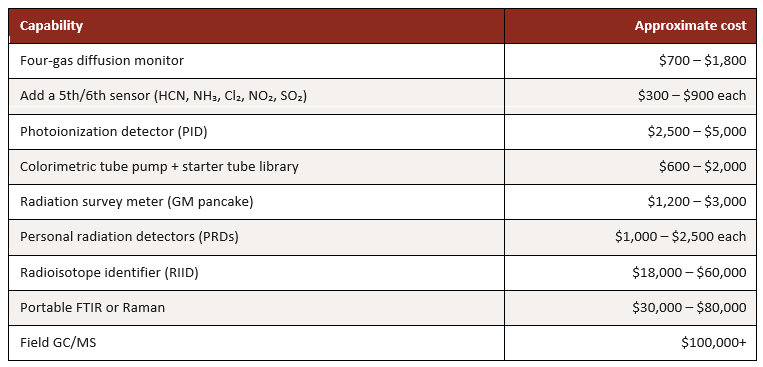
A chief can outfit every apparatus in a mid-size department with four-gas meters for the price of one Raman. That math is why the exotic gear lives on the regional hazmat team and the engine company gets four sensors and a prayer.
Federal and state grant programs fund what fits a clean, defensible narrative. “Replace 12 aging four-gas meters” writes itself. “Fund a PID, a tube library, dosimetry for 60 members, and 40 hours of interpretation training per shift” requires an applicant who already understands the gap, which is precisely the population we’re short on.
And the honest one? Four-gas is easy to train.
Bump it, zero it, read four numbers, respond to an alarm. You can teach the button-pushing in 20 minutes. A PID requires you to understand ionization potentials and correction factors. Colorimetric tubes require you to know what you’re looking for before you sample. Radiation instruments require you to understand what the units mean.
Every capability past four-gas carries a training tail longer than the procurement, and training tails are where programs quietly die.
That last point is the real thesis of this article. The equipment gap is a symptom. The competency gap is the disease.
Here is the part I’d ask every safety professional reading this to sit with, because these are not edge cases. These are Tuesdays.
Blind Spot 1: LEL is a fire scale, not a health scale
This is the single most important concept in this article, and it’s the one most often missed.
The LEL sensor reports flammability as a percentage of the lower explosive limit. It says nothing about toxicity. For some chemicals those two scales are close enough that the LEL reading gives incidental health protection. For others they are separated by orders of magnitude.
Run the arithmetic on benzene.
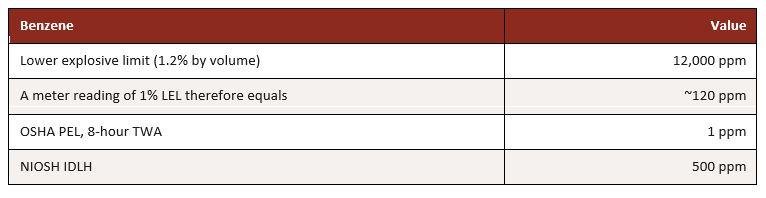
So a meter displaying “1” — a number most crews would dismiss as drift or noise, well below any alarm point — corresponds to roughly 120 times the permissible exposure limit for a known human carcinogen. You’d need to reach about 4% LEL to hit IDLH. Your meter’s low alarm probably sits at 10%.
Also Read: How we Train: The Basics
Hydrogen sulfide runs the same trap in reverse, and worse: H₂S has an LEL of 4% — 40,000 ppm — while its IDLH is 100 ppm, or 0.25% of LEL. If you were watching the LEL bar for H₂S, you’d be dead before the display moved off zero.
That’s why H₂S has its own dedicated toxic sensor. Benzene, toluene, xylene, styrene, methylene chloride, hexane, and a hundred other common industrial vapors do not.
Teaching point: The LEL channel protects the building. The toxic channels protect the person. If a hazard doesn’t have a dedicated toxic sensor on your instrument, you are not monitoring for it — you are monitoring for whether it will explode.
Blind Spot 2: The oxygen sensor is a terrible proxy for asphyxiants
Everyone knows the oxygen sensor catches displacement. Fewer people have done the math on how much displacement it takes.
Carbon dioxide’s IDLH is 40,000 ppm — 4% by volume. If CO₂ displaces ambient air proportionally, at 4% CO₂ the oxygen concentration reads 20.9% × 0.96 = 20.06% oxygen.
Your low-oxygen alarm is at 19.5%. You can stand in an IDLH CO₂ atmosphere with the oxygen sensor reading essentially normal. This is not theoretical.
Modern supermarket refrigeration racks increasingly use CO₂ as the primary refrigerant. Restaurants and bars have bulk CO₂ for beverage carbonation, frequently in basements and closets. Breweries, indoor grow operations, welding shops, dry ice storage, and fire suppression systems all concentrate it. CO₂ is heavier than air and pools in low spots — which is exactly where the person who collapsed is lying.
Simple nitrogen or argon displacement will move the oxygen sensor honestly, and the sensor deserves credit for that. But an oxygen reading of 20.9% means the oxygen fraction is normal. It does not mean the air is safe, and it never has.
Blind Spot 3: Catalytic bead sensors fail in ways that read as good news
The traditional LEL sensor is a catalytic bead — it burns the sample gas on a heated element and measures the resistance change. That mechanism has three consequences most responders were never taught:
- It needs oxygen to work. In an oxygen-deficient atmosphere (below roughly 10–12%), the bead can’t sustain combustion, and the LEL reading falls toward zero while the flammable concentration is rising. In a heavily inerted or gas-flooded space, the catalytic bead can under-report catastrophically at exactly the moment accuracy matters most.
- It gets poisoned, sometimes permanently. Silicones (lubricants, sealants, some hair and skin products), high-concentration H₂S, halogenated hydrocarbons, and lead compounds degrade or destroy bead sensitivity. A poisoned bead does not throw an error — it reads low. This is the entire argument for bump testing before every use rather than trusting the last calibration sticker.
- It’s calibrated to one gas and lies about the others. Most fire service instruments are calibrated to methane or pentane. Every other fuel requires a correction factor, and those factors are not small. A meter calibrated on methane and exposed to a heavier hydrocarbon may under-read by a factor of two or more. If your meter says 10% LEL and the actual value is 25%, you have made a decision on a number that isn’t real.
Infrared LEL sensors solve the oxygen dependence and the poisoning, and they read reliably up to 100% by volume. This matters enormously on a ruptured natural gas main, where a catalytic bead can pass through its peak and read low in an atmosphere far above the upper explosive limit.
IR sensors are blind to hydrogen, which is its own growing problem. There is no free lunch here; there is only knowing which lunch you bought.
Blind Spot 4: Cross-sensitivity generates confident wrong answers
Electrochemical sensors respond to more than their target gas.
The classic: CO sensors respond strongly to hydrogen. Lead-acid battery charging rooms produce hydrogen. Lithium-ion cells in thermal runaway produce hydrogen. Some fuel cell and electrolyzer installations produce hydrogen by design.
Crews chase “carbon monoxide” readings in these environments and reach the wrong conclusion about both the hazard and the fix. CO sensors also respond to acetylene, ethylene, and ethanol.
H₂S sensors respond to other sulfur compounds, mercaptans, and NO₂. Sulfur dioxide sensors respond to H₂S. The manufacturer publishes cross-sensitivity tables for every cell in the instrument. Almost nobody in the fire service has read them.
An instrument does not detect a chemical. It detects a response. Attributing that response to a specific substance is an act of interpretation performed by a human being — and it can be wrong.
Blind Spot 5: Entire hazard classes get no response at all
A four-gas meter has essentially zero response to these seven situations.
- Hydrogen cyanide is produced abundantly by burning polyurethane foam, nylon, wool, silk, and acrylics. It’s the other half of the “toxic twins” with CO; it’s synergistic with CO, and it’s a dominant overhaul hazard in every modern residential fire.
- Where there’s chlorine, ammonia, sulfur dioxide, nitrogen dioxide, phosgene. Pools, water treatment, refrigeration, agriculture, ice arenas, and any fire where a chlorinated compound meets flame.
- Where volatile organic compounds fall below the LEL. As shown above, is where the health hazard actually lives.
- Where there is ionizing radiation. Nuclear medicine, industrial radiography, well logging sources, density gauges, legacy check sources in school science storerooms, orphaned sources in scrap metal.
- Where there are corrosives, oxidizers, and reactives as liquids or solids. An unknown puddle is invisible to a gas meter.
- Where there are particulates and fibers such as asbestos, silica, metal fumes, combustion products.
- Where there are isocyanates, mercury vapor, phosphine, methyl bromide, and most fumigants.